Margin vs Markup: The Difference That Costs Businesses Money
Margin and markup use the same two numbers but mean different things. How to calculate each, why they are not equal, and a quick reference table.
Last updated: September 2026
Margin and markup are the most confused pair in small-business pricing. They use the same two numbers — cost and selling price — but express the profit against a different base, so the percentages are never the same. Mixing them up quietly eats into profit.
The two definitions
Profit margin is profit as a percentage of the selling price: (price − cost) ÷ price × 100. Markup is profit as a percentage of the cost: (price − cost) ÷ cost × 100.
Worked example: you buy an item for 40 and sell it for 100. The profit is 60. Margin is 60 ÷ 100 = 60%. Markup is 60 ÷ 40 = 150%. Same deal, two very different percentages.
Why they are never equal
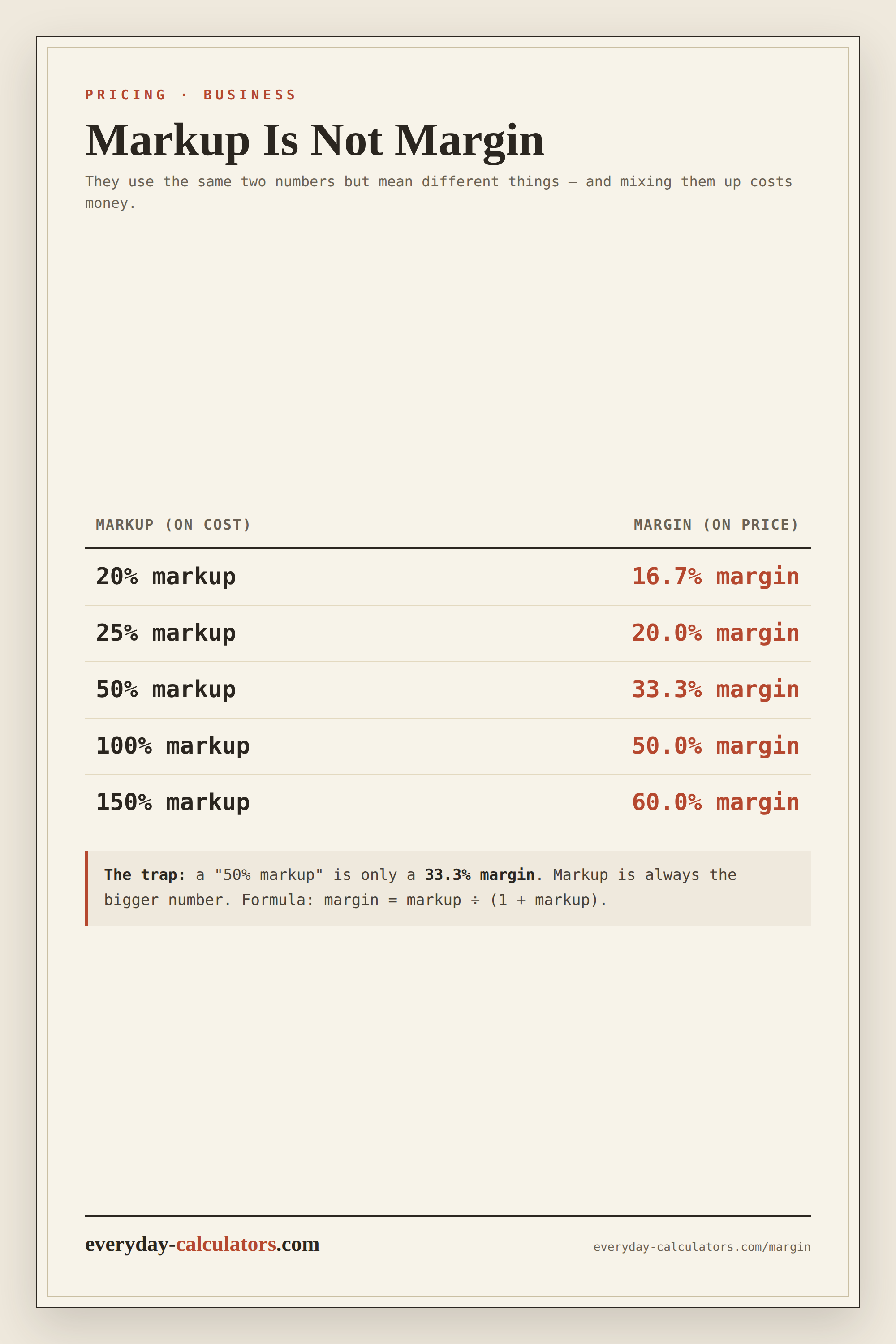
Markup is always the larger number, because cost is smaller than price, so dividing by it gives a bigger percentage. The gap widens as profit grows. This is the trap: a supplier who says "50% markup" is not giving you a 50% margin — a 50% markup is only a 33.3% margin.
| Markup | Margin |
|---|---|
| 20% | 16.7% |
| 25% | 20.0% |
| 50% | 33.3% |
| 100% | 50.0% |
| 150% | 60.0% |
Computed from the definitions above: margin = markup ÷ (1 + markup).
Which one to use
Retailers and accountants usually talk in margin, because it tells you what share of each sale you actually keep. Markup is handy at the counter for setting a price from a known cost. Just be sure everyone in a negotiation means the same one.
Set your price
The margin calculator takes a cost and a price and shows the profit, the margin and the markup together, so you can see both at once and price with your eyes open.
Try the margin calculator →← All guides