MPG vs L/100 km: Understanding Fuel Economy
How miles per gallon and litres per 100 km relate, a conversion table, why US and UK mpg differ, and how to work out what a trip really costs.
Last updated: September 2026
Fuel economy is quoted two ways, and they run in opposite directions. Miles per gallon (mpg) measures distance per unit of fuel, so higher is better. Litres per 100 km (L/100 km) measures fuel per unit of distance, so lower is better. Knowing how to move between them makes it easy to compare cars or work out a trip.
The conversion
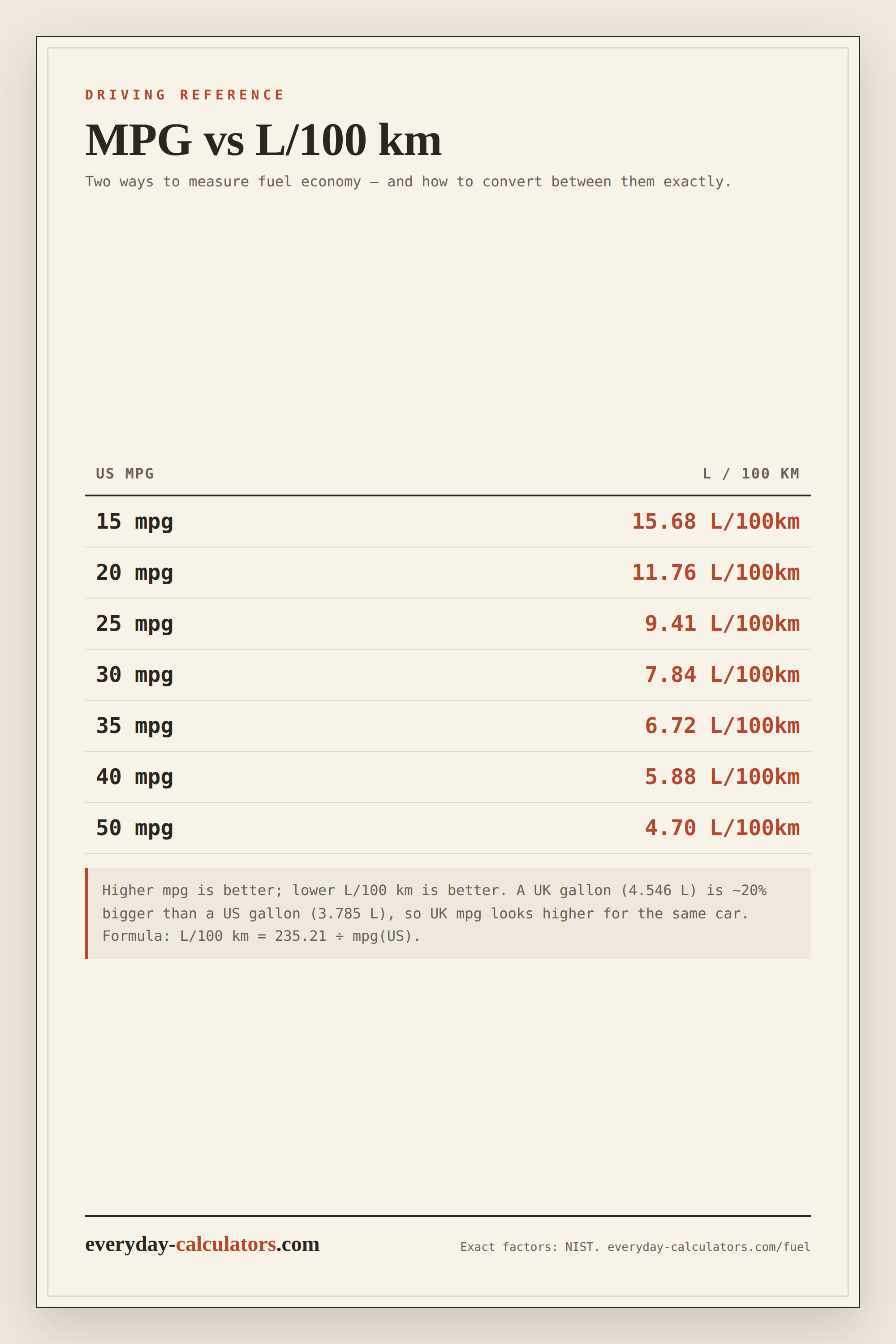
Because a US gallon and a UK gallon differ, the conversion factor differs too. For US mpg, L/100 km = 235.21 ÷ mpg; for UK mpg, L/100 km = 282.48 ÷ mpg.
| mpg (US) | L/100 km |
|---|---|
| 15 | 15.68 |
| 20 | 11.76 |
| 25 | 9.41 |
| 30 | 7.84 |
| 35 | 6.72 |
| 40 | 5.88 |
| 50 | 4.70 |
Derived from exact unit definitions (NIST): 1 US gal = 3.785411784 L, 1 UK gal = 4.54609 L, 1 mile = 1.609344 km.
Why US and UK mpg are not the same
A UK imperial gallon (4.546 L) is about 20% bigger than a US gallon (3.785 L), so the same car scores a higher number in UK mpg than in US mpg. A "40 mpg" car in Britain is not as efficient as a "40 mpg" car in the States. When in doubt, convert both to L/100 km, which has no such ambiguity.
What a trip actually costs
The cost of a journey is simply the fuel used times the price. In metric: fuel used = distance ÷ 100 × consumption. A 500 km drive at 6.5 L/100 km uses 500 ÷ 100 × 6.5 = 32.5 litres; at 1.80 per litre that is 32.5 × 1.80 = 58.50 — about 0.12 per kilometre.
Real consumption varies with speed, load, traffic and weather, so treat any figure as a close estimate. Steady speeds, correct tyre pressure and less weight all help.
Do the maths for your trip
The fuel cost calculator works out fuel needed, cost per km or mile and total trip cost, in metric or US units, so you do not have to mix the two by hand.
Try the fuel cost calculator →← All guides