What Is a Healthy BMI — and How Many Calories You Need
How to read your BMI, what the categories mean, the limits of the number, a healthy-weight-by-height table, and how daily calorie needs are estimated.
Last updated: September 2026
Body mass index (BMI) is a quick way to see whether your weight is in a healthy range for your height. It is a screening tool, not a diagnosis, but it is a useful starting point.
How BMI is calculated
BMI is your weight in kilograms divided by your height in metres squared. Someone 1.75 m tall weighing 68 kg has a BMI of 68 ÷ (1.75 × 1.75) = 22.2. The BMI calculator works it out in metric or imperial units.
The categories (WHO)
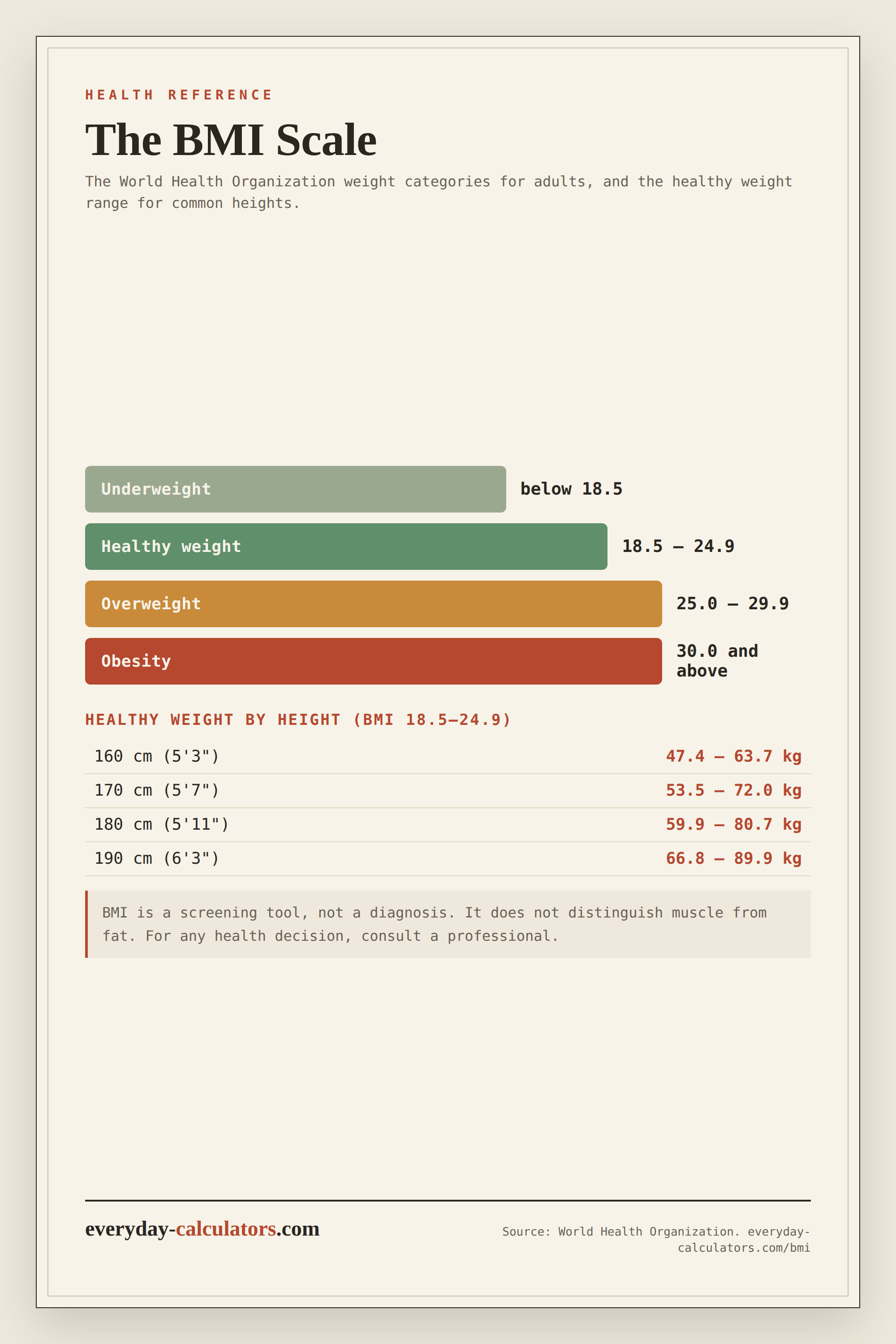
The World Health Organization bands for adults are the same for men and women:
| Category | BMI (kg/m²) |
|---|---|
| Underweight | below 18.5 |
| Healthy weight | 18.5 – 24.9 |
| Overweight (pre-obesity) | 25.0 – 29.9 |
| Obesity class I | 30.0 – 34.9 |
| Obesity class II | 35.0 – 39.9 |
| Obesity class III | 40.0 and above |
Source: World Health Organization classification (World Obesity Federation).
Healthy weight range by height
A healthy BMI (18.5–24.9) corresponds to a weight range at each height. These are computed straight from the BMI formula:
| Height | Healthy weight |
|---|---|
| 155 cm (5'1") | 44.4 – 59.8 kg |
| 160 cm (5'3") | 47.4 – 63.7 kg |
| 165 cm (5'5") | 50.4 – 67.8 kg |
| 170 cm (5'7") | 53.5 – 72.0 kg |
| 175 cm (5'9") | 56.7 – 76.3 kg |
| 180 cm (5'11") | 59.9 – 80.7 kg |
| 185 cm (6'1") | 63.3 – 85.2 kg |
| 190 cm (6'3") | 66.8 – 89.9 kg |
Where BMI falls short
BMI does not tell muscle from fat, so very muscular people can read as overweight, while older adults may carry less muscle than the number suggests. For children and teenagers, doctors use age- and sex-specific percentiles instead. Waist measurement adds useful context about where fat is stored.
How many calories you need
Daily calories start from your resting metabolism — the energy your body uses at rest — estimated with the Mifflin-St Jeor equation from your weight, height, age and sex. That figure is multiplied by an activity factor, from sedentary to very active, to estimate what you burn in a day.
Using the numbers
To maintain weight, eat around your daily calorie estimate; a moderate deficit or surplus shifts weight slowly and sustainably. Treat all of this as a guide, and speak to a professional for personal health decisions.
Not medical advice. BMI is a screening tool, not a diagnosis. It does not distinguish muscle from fat, and lower cut-offs are recommended for some populations (for example, many Asian groups). It is not used for under-18s or during pregnancy. For any health decision, consult a qualified professional.
Try the BMI calculator →← All guides