Everyday Calculators
Seventeen simple tools for the numbers that come up every day — tips, percentages, loans, VAT, savings, debt, margin, fuel cost, BMI and more. Pick one to get started.
Tip
Percentage
Discount
VAT
VAT Calculator — add tax to a net price
This VAT (Value Added Tax) calculator adds tax to a net price and shows both the tax amount and the gross, tax-inclusive total. It is handy for invoices, quotes, freelancers and online shopping across Europe.
How to calculate VAT
Multiply the net price by the VAT rate to get the tax, then add it to the net price for the gross total. Choose a common rate (21%, 20%, 19% or 9%) or enter your country’s rate.
Standard VAT rates in Europe (2026)
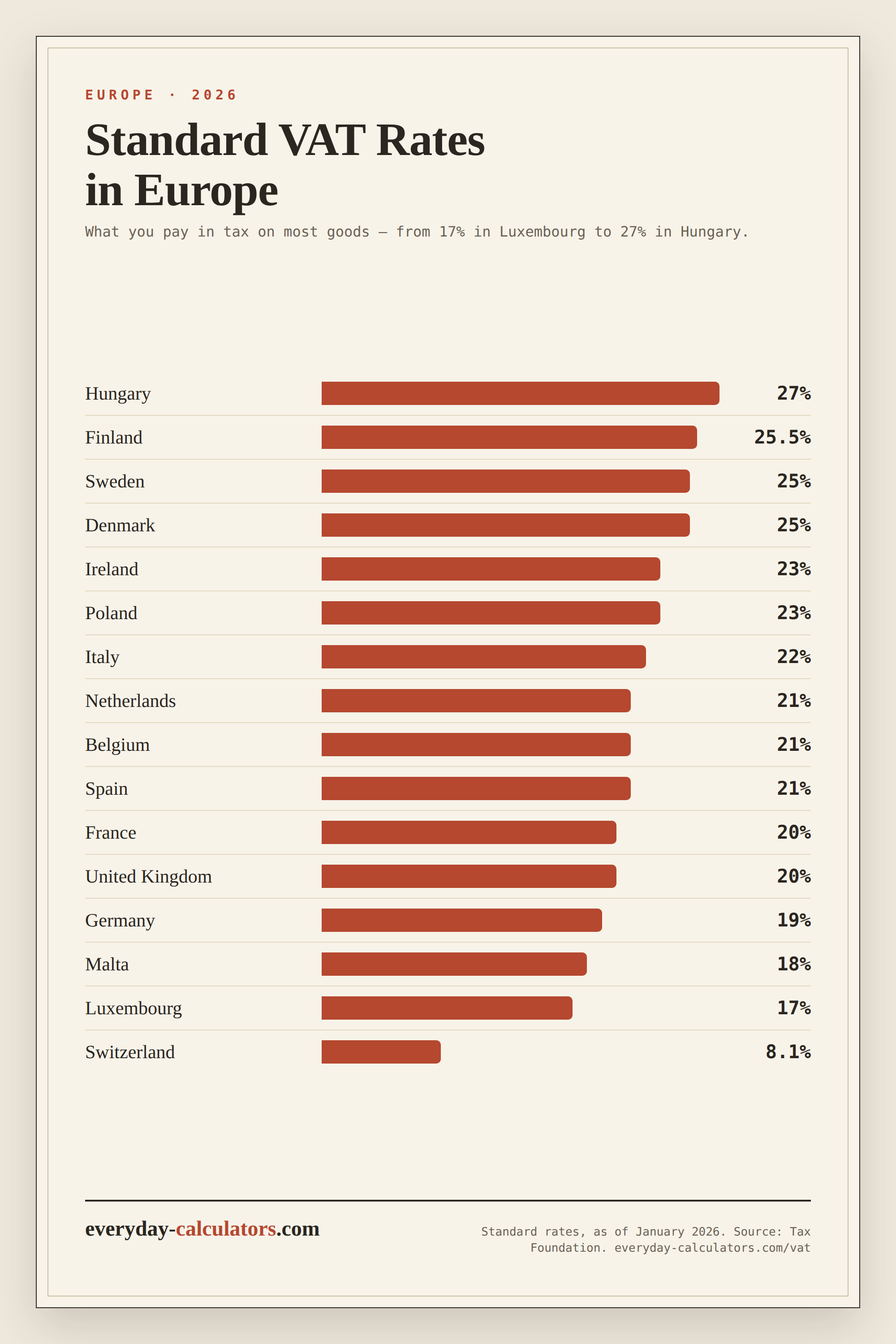
Standard rates vary widely across Europe — from 17% in Luxembourg to 27% in Hungary. The table below lists the standard rate for every EU country plus the UK, Switzerland and Norway. Most countries also apply lower reduced rates to essentials such as food, books and medicine.
| Country | Standard rate |
|---|---|
| Austria | 20% |
| Belgium | 21% |
| Bulgaria | 20% |
| Croatia | 25% |
| Cyprus | 19% |
| Czechia | 21% |
| Denmark | 25% |
| Estonia | 24% |
| Finland | 25.5% |
| France | 20% |
| Germany | 19% |
| Greece | 24% |
| Hungary | 27% |
| Ireland | 23% |
| Italy | 22% |
| Latvia | 21% |
| Lithuania | 21% |
| Luxembourg | 17% |
| Malta | 18% |
| Netherlands | 21% |
| Poland | 23% |
| Portugal | 23% |
| Romania | 21% |
| Slovakia | 23% |
| Slovenia | 22% |
| Spain | 21% |
| Sweden | 25% |
| United Kingdom | 20% |
| Switzerland | 8.1% |
| Norway | 25% |
Standard rates only, as of January 2026. Source: Tax Foundation, “VAT Rates in Europe”. Reduced rates apply to many goods and services.
Verify before you rely on it. VAT rates change and reduced rates vary by product. Always confirm the current rate for your specific goods with the national tax authority before invoicing or pricing.
Removing VAT from a gross price (reverse VAT)
To find the net price from a tax-inclusive price, divide by 1 plus the rate. At 21%, divide the gross by 1.21: €121 ÷ 1.21 = €100 net, so the VAT is €21. This tool adds VAT to a net price; for the reverse, divide as shown.
Standard and reduced rates
Most countries have a standard rate plus one or more reduced rates for essentials such as food, medicine, books and public transport, and some zero-rated or exempt categories. Use the rate that applies to your specific goods, and confirm the current figure with your tax authority.
VAT for freelancers and small businesses
If you are VAT-registered, you charge VAT on sales and can reclaim VAT on business purchases, paying the difference. Keep the net and VAT amounts separate on every invoice — this calculator gives you both.
How VAT is added and removed
To add VAT, multiply the net price by one plus the rate: at 21%, a net of 100 becomes 100 × 1.21 = 121. To remove VAT from a gross price, divide instead: 121 ÷ 1.21 = 100. Rates are set by each country and change from time to time — much of the EU sits around 19–21% — so check your national tax authority for the current figure.
Bill Split
Unit Converter
Loan & Mortgage
Mortgage
Salary Converter
Compound Interest
BMI & Calories
Date & Age
Time & Hours
Debt Payoff
Area
Margin & Markup
Fuel Cost
FAQ
How do I add VAT to a net price?
Multiply the net price by (1 + rate ÷ 100). €100 plus 21% VAT is €121.
How do I remove VAT from a gross price?
Divide the gross price by (1 + rate ÷ 100). €121 gross at 21% is €100 net.
What VAT rate should I use?
It depends on country and product — standard rates are 20% UK, 21% NL and BE, 19% DE, 20% FR. Check your local rate.